When Stephen Kuhrt began to minister in his parish in South West London, he didn’t expect to uncover a historical safeguarding issue. Having raised the problem with his diocese, he was totally unprepared for their reaction.
What followed exposed alarming cracks in the Church of England’s safeguarding practice, and the disturbing treatment of those who dare to speak out. Stephen and his supportive parishioners had certainly not expected he would be suspended after following his own moral compass and ‘doing the opposite of a Justin Welby’ as he later said during a TV interview about it in 2024.
SAFEGUARDING THE INSTITUTION delivers a searing critique of the culture of the Church of England. Kuhrt lays bare a system plagued by pragmatic evasiveness, passive aggression and an ethos of wilful incompetence. He exposes its fear-driven decision making, double standards, and dishonesty surrounding sexuality and clerical accountability.
But this is not a book without hope, as Stephen refuses to give up on the church which he has loved all his life.
In the wake of this and other recent safeguarding scandals, Stephen’s book reimagines a different kind of church, rooted in a proper confidence in the gospel of Jesus Christ and shaped by truth-telling, courage, and integrity.
From parish life to national leadership, this is a bold and practical manifesto for cultural transformation across the whole of the Church of England, to rediscover a church that will safeguard its members rather than its own institution.
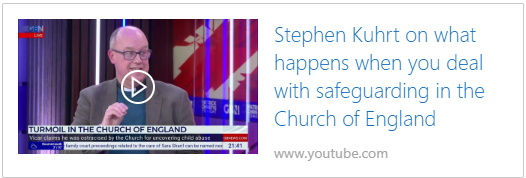
Stephen spoke on TV about this experience. You can watch his interview with Patrick Christys on YouTube.
Stephen Kuhrt is “making a clarion call to us all in the Church to examine our power structures and to recognise our failings, particularly in regard to truth, and impact of its lack on safeguarding.
Should be required reading for everyone, especially church leaders, clergy and ordinands and those training them.” said a Canon in the Church of England
“It is an explanation of how difficult problems in churches should not be swept under the carpet by massaging the truth, using scripture to justify doing nothing, or simply giving in to the most influential people in the congregation for fear of upsetting the apple cart.
Fundamentally, it is an appeal to Christians to own up to their own shortcomings.
… Stephen’s focus is how to make God’s presence and character a reality in the church today. The message is that if we hide our mistakes we can never learn from them.” Nathan Driscoll on Amazon.co.uk
